Vehicle valuation literacy
How to Evaluate an AI Vehicle Price Report Before Relying on Its Advice
Separate user-entered details, genuine market evidence and modeled guidance when reading an AI-assisted used-car pricing report.
Identify which details are user supplied
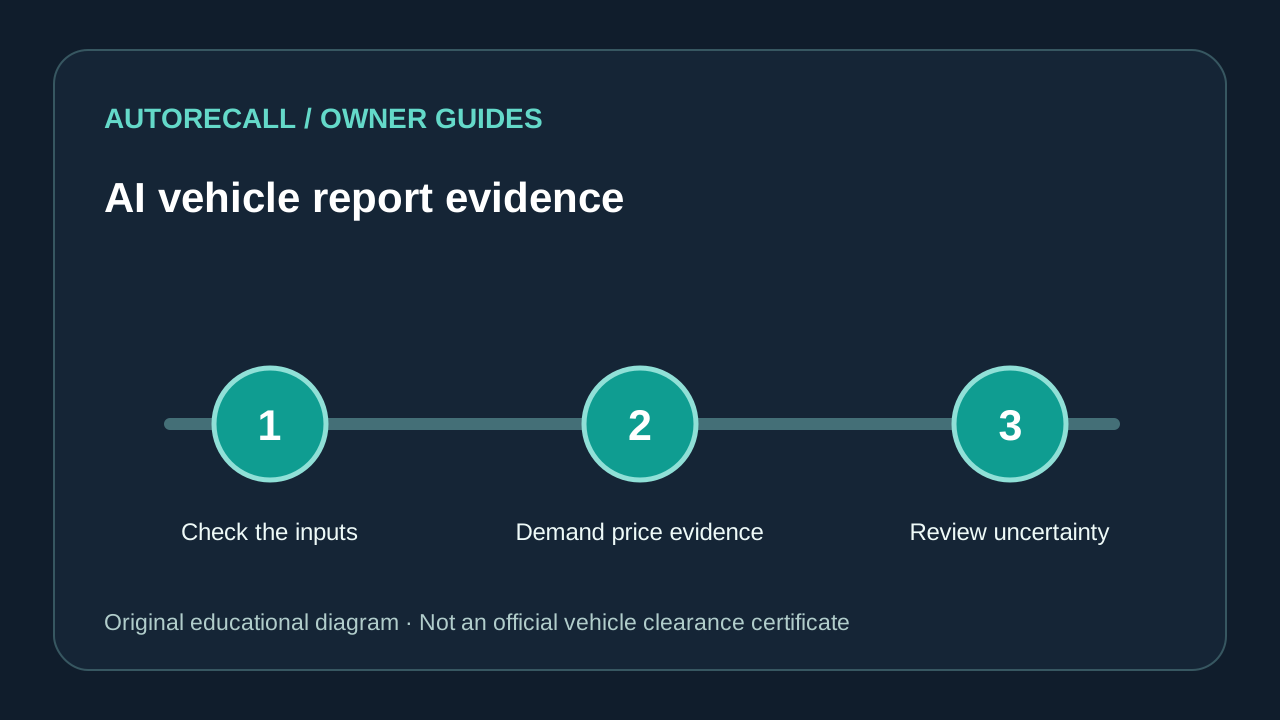
An AI-assisted vehicle report usually begins with details typed by a seller or buyer: year, make, model, mileage, condition, location and asking price. Those inputs are not independently verified facts simply because they appear in a professional-looking PDF or web page. Look for an explicit statement of what came from the user, what came from a trusted external source and what was inferred by the model. A confidence label without supporting data is not evidence.
Start by checking the country code, currency, mileage unit, model variant and asking price. A market code such as AE should be interpreted as the United Arab Emirates rather than a generic regional label. A conversion error between kilometers and miles or AED and USD can distort the discussion before any economic analysis begins.
Ask where the monetary estimate comes from
A defensible price range normally depends on comparable vehicles in the same market, adjusted for year, variant, mileage, condition and timing. The report should distinguish asking prices in listings from actual completed transaction prices. If no current local comparisons were available, the author should say so clearly. In that situation, a report can still be useful as a condition and risk checklist, but it should not present a specific market value as externally verified.
An apparently precise figure is not automatically more trustworthy than a range. Ask whether each major adjustment has a stated basis and whether the same logic would apply to a slightly different trim or mileage. An estimate without any comparable evidence should be treated as a preliminary opinion, not a professional appraisal or guaranteed resale outcome.
Assess risk and uncertainty
Vehicle history is often incomplete. Accidents may go unreported, repairs may be performed outside manufacturer networks, and imported vehicles may lack continuous records. AI cannot inspect a chassis, test a battery or verify paint thickness through a text prompt. Recall notices likewise may identify model campaigns without confirming whether an individual VIN has an unresolved remedy. A sound report makes these blind spots visible and suggests practical checks instead of hiding them beneath a single score.
Look for a prioritized checklist: official recall research, identification verification, independent inspection, service-history review, accident and ownership checks where lawfully available, and local market comparisons. Those steps convert a generic essay into something a buyer can act on. Uncertainty should lead to a verification task, not an invented statistic.
Use a report as a decision aid
A paid report can help structure questions and compare scenarios, but the payment itself is not a warranty of accuracy. Make sure the service explains what it does and does not deliver, how user data is handled and where support is available. If the report mainly repeats the car description, consider whether additional inspection or source information is necessary before relying on it for a purchase.
Keep an evidence file with actual comparable listings or sales, inspection findings, dealer responses, recall references and your own assumptions. Revisit the report when stronger evidence becomes available. The best use of AI guidance is to make the buyer more systematic and better informed, while leaving final safety judgments and financial commitments to confirmed facts and qualified local expertise.
A checklist for inspecting the final report
Read the summary and highlight every claimed fact. For each one, ask whether it is a field you entered, a statement supported by an identified external source, or a generalized assumption. If the report contains a resale price, identify the comparable listings or completed transactions used to support it. If those are missing, ask for a revised explanation that describes limitations rather than claiming a verified market value. Review the currency, country, mileage and model variant a second time before any negotiation.
Finally, compare the report against the practical next steps. Does it identify an independent inspection, manufacturer recall checks and documents worth requesting? Does it avoid promising accident-history access it never obtained? Does it clearly distinguish a preliminary price discussion from a professional appraisal? A useful report should make those boundaries visible. When the evidence is inadequate, its best contribution may be a focused list of questions to resolve before committing money.