Vehicle safety guides
How to Check a Vehicle Recall Without Confusing Model Matches and VIN Status
Understand the difference between recall campaign listings and vehicle-specific repair confirmation before deciding what a search result means.
Start with the right question
A vehicle recall is a safety campaign, not a universal verdict on a used car. A public search might return a campaign affecting a manufacturer or model family. That result does not automatically establish that the exact vehicle you are considering is included. Manufacturing dates, trim, components and regional specifications may narrow the affected population. Begin by recording the make, model, model year and market where the vehicle was supplied. Then consult the manufacturer and the appropriate official regulator for that market.
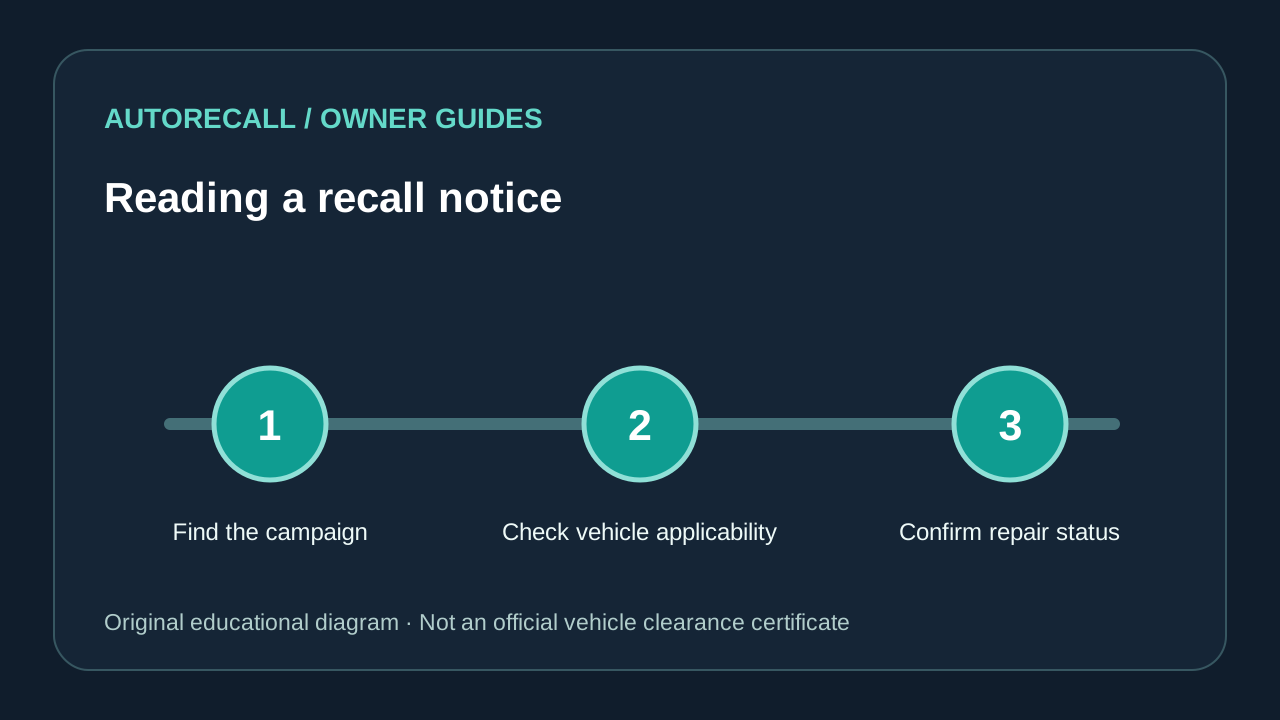
There are at least three different questions to answer: whether a campaign exists, whether the particular vehicle is affected, and whether an affected vehicle has received the remedy. Keep those questions separate in your notes. A blank campaign-listing search does not prove every database is complete, and a campaign listing does not show that a particular VIN has an unresolved repair.
Read the notice rather than only the headline
A useful campaign notice describes the affected products, the safety defect, the possible hazard and the corrective action. Look for the official campaign reference and publication date. If a notice names several model years, do not assume that every example built during those years is included. Read any production date, engine, component or variant limitation provided by the regulator or manufacturer. A brief summary on a third-party website may omit precisely the detail that determines applicability.
Save the notice URL and the manufacturer contact details. If you see a supplementary regional product-safety alert, check whether it is a vehicle campaign or a broader product warning. Alerts for tires, child seats or accessories may be relevant to ownership without describing a recall of the entire car. AutoRecall labels limited notices as supplementary for this reason.
Use vehicle-specific tools when available
In the United States, the NHTSA VIN recall lookup is designed to check relevant incomplete safety recalls within the scope shown by that service. Canada also provides government recall resources and manufacturer information. The United Kingdom offers official checks using registration details or manufacturer, model and year. Each service has its own scope and update process. A country-directory link is not a promise that AutoRecall has access to that government's vehicle-level repair database.
If an official vehicle-level tool is unavailable, ask the manufacturer or authorized dealer to check the complete identification number against its service campaign system. Do not paste a customer VIN into unverified websites or public comments. A physical inspection and written manufacturer confirmation are more valuable than a green tick from an incomplete model-level dataset.
Decide what to do next
When a potentially relevant campaign appears, contact the manufacturer with the campaign reference and vehicle details. Request written confirmation of applicability, any open corrective action and how to schedule it. Keep copies of service invoices or completed campaign records. Some remedies can be performed immediately; others depend on parts availability or scheduling. Follow the actual safety instructions in the notice rather than assuming a vehicle may be driven normally while waiting.
Repeat the official check when ownership changes, when the manufacturer sends an update, or when a new campaign is announced. Recall status can change over time. Your final record should distinguish what the public dataset showed, what the manufacturer confirmed, and what repairs were documented. That distinction prevents both false reassurance and unnecessary alarm.
A compact record you can keep
Make a simple research log with the date you checked, the country and service searched, the manufacturer and model you entered, the official campaign references returned, and the exact question still open. Include a separate line for manufacturer confirmation and one for evidence of repair. This format works even when the original search was made by a seller, dealer or family member. It prevents an old screenshot from being mistaken for a current manufacturer record, and it allows a later buyer to trace what was actually checked.
If you share the research with someone else, omit complete VINs, private owner documents, checkout credentials and personal contact information unless the recipient has a legitimate need for them. A campaign notice URL and a limited description are usually enough to begin a discussion. The result should help the next person verify the issue directly, not require them to trust your interpretation without access to the official source.