International recall research
Why Recall Search Results Differ Across Countries and Data Sources
Learn why official campaigns, regional product alerts and supplementary third-party notices cannot be treated as identical recall databases.
A recall listing is tied to a jurisdiction
Vehicle safety regulators use different laws, reporting frameworks and publication systems. A campaign announced for one market may refer to vehicles manufactured for that region, a specific supplier batch or a national regulatory requirement. A similar vehicle sold elsewhere can have different components, trim specifications and campaign arrangements. That is why a search result from one country should not automatically be presented as a confirmed local recall in another.
Cross-border and imported vehicles deserve particular care. The origin market, registration market and repair-service market can differ. A US recall record may be valuable historical context for an imported vehicle in the UAE, but it is not itself evidence of a UAE government campaign or proof that the car qualifies for the same local remedy process.
Different sources answer different questions
An official national vehicle recall feed can list campaigns, remedies and affected products. A vehicle-specific manufacturer check may also indicate whether an individual VIN is affected or has an open remedy. A regional product-safety alert might concern a tire, charger or accessory without covering all vehicles associated with that product. Third-party notice aggregators can help readers find older or distant announcements, but their coverage depends on what they collected and how often they refresh it.
A homepage selector should therefore identify what the selected country can actually offer. Labels such as national feed, official checker, supplementary notice and referral describe different capabilities. They should not be combined into a single reassuring status. Source date and last successful update matter as much as a count of results.
Read incomplete results correctly
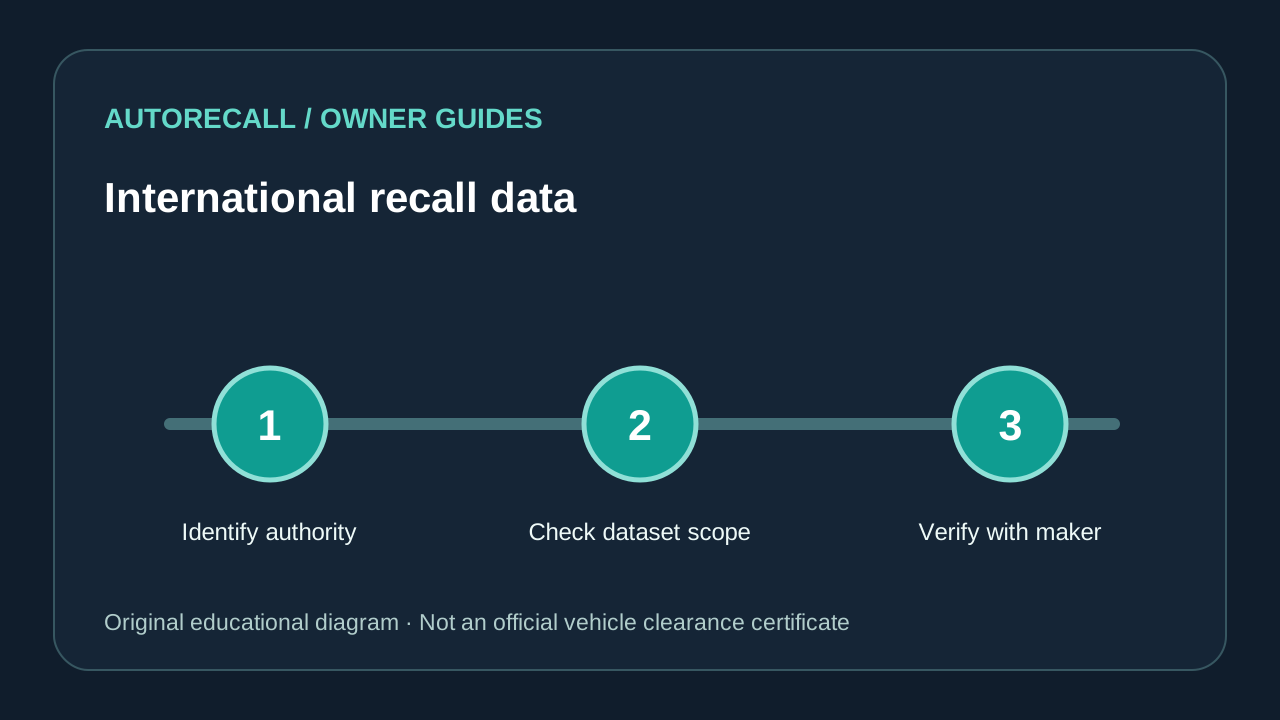
Suppose a model search returns two campaign notices from a supplementary index. That establishes that the dataset contains those notices; it does not establish that only two recalls exist. Likewise, a blank result may mean the dataset lacks historical depth, excludes some authorities, or could not resolve a variant name. It should never automatically be turned into an all-clear safety certificate.
For a consequential purchase or safety concern, open the original notice and follow the official checker or manufacturer contact for the vehicle's registration market. Save the notice reference and explain what additional evidence is needed to determine vehicle applicability and remedy completion. This approach gives visitors useful research without implying unearned certainty.
Use AutoRecall as a research starting point
AutoRecall combines several types of sources. Its original United States, Canada and France national integrations have been individually validated, while the Netherlands page contains a mapped subset of RDW campaigns. The United Kingdom, Australia and several other countries currently offer supplementary notices or external lookup routes rather than complete national VIN clearance. The inventory may evolve, so always read the source label on the live page.
Treat the result as one item in a broader process: verify the country and model, follow the official record, contact the manufacturer where needed, and document the outcome. Better search access helps people ask better questions. It does not replace the people or official systems responsible for determining whether a particular vehicle needs a repair.
A practical source-quality scorecard
When comparing two databases, write down the publisher, jurisdiction, update timestamp, data type and vehicle identifiers supported. Note whether the service is operated by a regulator, links to one, or repackages published notices. Check whether the result is a historical campaign record, an alert for automotive equipment or a manufacturer-confirmed repair status. A source can be genuinely useful while being unsuitable for the specific yes-or-no question a user wants to answer.
Freshness needs careful interpretation. A dataset updated yesterday may still cover only a small group of authorities, while a regularly refreshed official database may list historical campaigns whose individual vehicle repair states must be checked elsewhere. AutoRecall should disclose those differences near the search results and provide links to official sources. Visitors should not have to infer coverage from the country flag or the number of rows returned.