Used-car buying
Used-Car Recall and Safety Checklist Before Paying a Seller
Check campaign records, identification documents, inspection evidence and seller claims before making a used-car purchase decision.
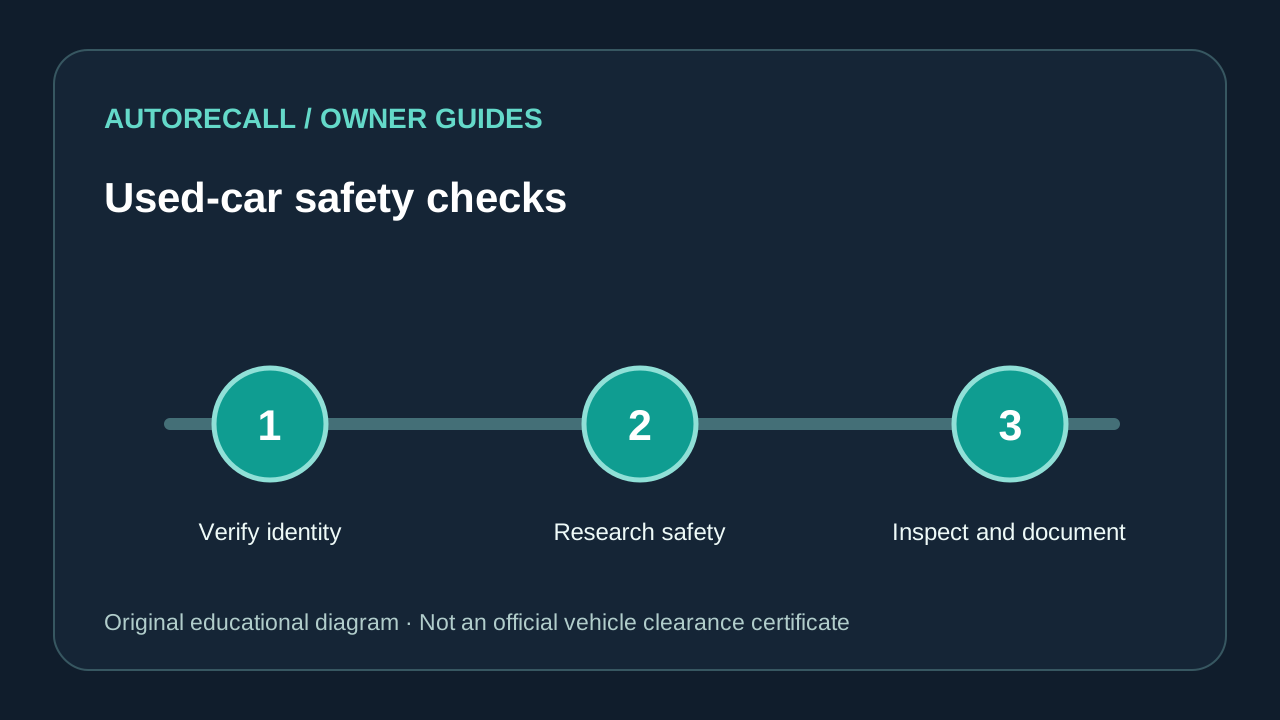
Verify the vehicle being offered
Before relying on any online listing, ask the seller for the vehicle identification details and supporting documents appropriate to the country. Confirm that the make, model, model year and identification numbers agree between the vehicle and its records. An advertisement can contain transcription errors, and imported cars may have specifications that differ from locally supplied versions. If the identification number on the vehicle or paperwork is altered or inconsistent, resolve that issue before proceeding.
For buyers in the United Kingdom, official guidance recommends checking registration, MOT and safety-recall information and comparing it with the vehicle and V5C record. Other markets use different registration and service-history systems. Do not assume a report written for one country can verify title, registration or repair completion in another country.
Investigate recalls separately from history
Search the relevant official safety campaigns by model and, where supported, by VIN or registration. Note the reference, affected production range, defect description and remedy status. A public campaign list may be incomplete for a particular model or time period. A lack of matches is better described as no matching records in the checked source than as proof that the vehicle has never had a safety problem.
Ask the seller for manufacturer repair evidence if a campaign may apply. Where recall information is ambiguous, contact an authorized service representative directly. Remember that a recall investigation is separate from checking theft markers, finance interests, collision repairs, odometer history and import documents. Each answers a different question and may require a different trusted source.
Inspect condition and repair quality
Arrange an independent mechanical and structural inspection suited to the car and local conditions. A test drive alone cannot reveal all latent defects, and a generic digital report is no substitute for examining the actual vehicle. Ask the inspector to look for braking and steering faults, warning lights, unusual fluid leaks, corrosion, tire age, body repair quality and signs of water intrusion. For high-voltage vehicles, inspection must follow the manufacturer's safety procedures.
Compare service dates, mileage readings and repair descriptions for internal consistency. Gaps are not automatic proof of fraud, but they are reasons to request clarification. Record what the inspector could not observe, including hidden accident repairs or electronic faults that require specialist tools. Obtain permission and protect the seller's personal data when retaining photos or documents.
Make a transparent purchase decision
A fair price depends on local comparable vehicles, actual condition, mileage, equipment and expected maintenance costs. A seller's asking price is not a verified market value, and a single online estimate should not decide a major purchase. Use a range of comparable advertisements when no verified transaction data exists, and label advertised prices as listings rather than sold prices.
Before paying a deposit, get the key terms in writing: vehicle identity, promised repairs, inspection contingencies and which documents are included. Consider insurance, registration, taxes and any import compliance tasks. Keep the recall research, inspection findings and price reasoning together. This record helps you explain the decision later and prevents an attractive listing from obscuring unresolved safety questions.
A simple decision worksheet
Divide concerns into three groups before negotiating: items verified with records, matters identified during an independent inspection, and unanswered questions. For example, a dated manufacturer service invoice can be verified evidence, worn tires observed during inspection are a current condition issue, and an unexplained mileage gap is a question rather than a proven problem. This grouping stops rumors from being treated as facts and prevents a clean-looking dashboard from erasing genuine documentary gaps.
Estimate the cost and inconvenience of needed work only from credible local quotations. Write down the final total including transfer fees, insurance and near-term maintenance rather than comparing sticker prices alone. If safety-critical information remains unavailable, it can be reasonable to postpone the transaction. A seller who is unwilling to clarify core identification or repair records is providing less evidence, not necessarily proving wrongdoing; decide what level of uncertainty you are prepared to accept.